Bad Mother’s Day

I greet Mother’s Day every year with mixed emotions:  the joy of my own motherhood tinged with the pain of those who suffered at the hands of their mothers.  Facebook has intensified my camaraderie with the latter group, not because people post their painful memories.  They don’t.  Many people who were abused, unwanted, neglected or traumatized by their mothers know by instinct that they are supposed to remain silent on Mother’s Day. 

Not all mothers “mother” well.  I know people, mostly women, who were slapped, hit and locked out of their homes by their mothers.  I know people whose mothers verbally denigrated, criticized and scolded them beyond reason.  There are mothers who said to their child, “I should have aborted you”  as well as mothers who abandoned or routinely blamed or manipulated their child, creating deep wounds of neglect and injustice. 

You don’t read posts on Facebook about this type of mothering.  This time of year, posts feature mothers who laughed, loved unconditionally and mothered joyfully.  For people who did not have this kind of mothering, these posts can provoke envy and sadness, a wistful wondering what it would have been like to have a mother like that.  

Mother’s Day does not distinguish between good mothers and bad mothers.   Bad mothers are included.  And that is how it should be – often bad mothers never intended the depth of harm and trauma they inflicted.  They never knew – or they lost sight of – how to give of themselves and nurture their young rather than use and abuse their small charges for their own ends.  They often are unaware or regretful or in denial about the trauma they inflicted.  The recent child-abusive Time Magazine cover offers an example.  Commentators quickly questioned the judgment and emotional health of the model (as in “take my photo”) mother who used her camouflage clad 3 year old son as a breast-feeding prop.  Yet, it does not seem to have occurred to the publicity seeking mother that this sexualized, permanently online photo of her son standing on a chair to suck her breast might now, or later, traumatize him.     

Of course most mothers make some number of horrible mistakes in raising their children.  There’s no training for the job and the culture has increasingly urged modern mothers to keep their needs, goals and emotions primary.  Few women know that good mothering, good nurturing will entail a heart wrenching compromise of the self for most women.  Even those who feel willing to give of themselves so completely can find the daily challenge of containing one’s own emotions and needs formidable.  

Some mothers, though, get it all wrong from the beginning.  Without intervention, their horrible mistakes become a way of mothering and they end up traumatizing one or more of their children. 

People usually tell me their bad mother stories in whispers, over dinner with wine.  They talk about their trauma only to outsiders like me.  Their caution is wise.  Families often blame the victim for a mother’s cruelty and they resent – even reject – the member for sharing private family secrets.  Victims of bad mothering arrive at words like “abuse,” “neglect” and “abandonment” very slowly – as if the label implicates their own self worth.  Who wants the world to know that your own mother didn’t think you were worth caring for and loving properly?

For those traumatized by their mother, Mother’s Day is best embraced as a day of healing.  Traumatized children will spend years with emotional wounds that impact their lives, long after a mother has perhaps apologized or matured and corrected her parenting.  As one psychologist put it so well, traumas “do not end happily ever after but take years of working through to achieve healing.”  On Mother’s Day, as others say prayers of gratitude for the warm, nurturing love of their mother, victims of bad mothering must focus on acceptance, forgiveness and moving forward.  For some, this will include reconciliation with their mothers – others will find their voice and health only by leaving their mothers behind.

Mother’s Day is also a worthy day to recall those women in our lives who did love and nurture us.   Women have a unique role in conveying to the young “the values that embody our humanity . . . nurture, care, patience, self-sacrifice.”  (E. Fox-Genovese).  While we typically assume that mothers discharge this responsibility, other women often model these values in the lives of children – sometimes as an intentional palliative to the bad mothering they observe in a child’s life.  It is a worthy and comforting reflection to identify women from your childhood who conveyed such values to you – and to mark with gratitude their presence in your life.

Whether you honor today a woman who simply made some mistakes – or a mother who, through her own frailties and failings, traumatized you – find a way to include in your reflections true gratitude and forgiveness.  Try to model for others the virtues that eluded your mother in her care for you.  Extend yourself to a woman who may feel saddened because she did not, does not, have a loving, nurturing mother in her life.  Be that person for someone else today and celebrate Mother’s Day, the good and the bad.

Norsigian & Lahl: Hope for Feminism

On May 1 2012, a remarkable event occurred at the Bechtel International Center on the Stanford campus.


Sponsored by Stanford’s Office of Diversity and Leadership and Women’s Community Center, the program on human egg donation brought together Judy Norsigian, famed pro-choice feminist author of Our Bodies, Ourselves, and Jennifer Lahl, award-winning pro-life producer of Eggsploitation – two women with notably divergent views on abortion and the sanctity of unborn life.

Both women delivered the same message to young women targeted by aggressive recruitment and lucrative compensation for donating their eggs:  Don’t Do It. 

The message was timely.  Less than 30 days prior, this privately placed ad appeared in the Stanford Daily. 

Young women know that these sorts of ads appear regularly on college campuses.  Our young women know that, under the cover of “helping” less fertile, often older women and male same sex couples become parents, they are targeted for solicitation, harvesting and purchase of their eggs, much like a flower merchant with a great bulb to offer.

Young women know this – and they know that no one is offering much advice or protection.  Why are the adults so silent on this experimental commoditizing of our young women?  The technology is relatively new and, before Lahl’s Eggsploitation revelations, largely occurred below media radar, within the confines of medical confidentiality.  But older adults also remain silent in part from sheer ignorance of the industry’s unregulated marketing assault on young women.  If you haven’t seen these ads, it’s hard to believe.  Well educated adults, like this one, don’t realize that the industry is making a commercial market in human eggs extracted from young women – and they think ads like the one in the Stanford Daily “must be a joke; a late-running April Fool’s spoof.”

On the other hand, lots of people – lots of older women to be precise – know that it’s no joke at all.  In fact, it is often older women who patronize this industry, an organic human egg collective where consumers can pick and choose the particular product that suits their tastes.  

I don’t care how much money you pay these young women, it’s exploitative to turn desireable, fertile young women into a series of products which less desireable, less fertile older women (and men) can purchase.  From a feminist perspective, there is so much wrong with the human egg industry, it’s surprising that women are not demonstrating with signs “Hands Off My Eggs” or “Keep Your Dollars To Yourself” or “My Daughter’s Not for Sale.”  The Stanford event – and the appearance of Norsigian and Lahl united on this issue – finally gives purchase to some push-back as we belatedly realize that those targeted young women are our daughters, our nieces, our friend’s child – not egg harvesters’ guinea pigs.

Pushback is desperately needed.  Eggs are harvested from our young women using a untested, experimental procedure called “super ovulation” – which attempts to “trick” the woman’s body into ovulating a large litter of eggs at a set time tethered to the menstrual cycle of the woman who is scheduled for implantation of an embryo(s) from those eggs – rather than the natural 1-2 eggs per month a woman typically produce on her normal cycle.  It is impossible to get “informed consent” to this hormonal drug regime and invasive procedure because no one actually knows what the risks are.  Eggsploitation documents the fate of three women (one a doctor herself) who experienced stroke, infertility, breast cancer and other major physical effects as a result of hyperstimulation.  A 4th woman featured in the documentary, Jessica Wing, died young of a colon cancer that her mother, a doctor, believes may have resulted from Wing’s repeat super ovulations and egg retrievals.

The industry’s claim that these side effects were not from the procedure – or are rare and warranted by some higher purpose – is laughable since fertility doctors have successfully shielded themselves from studying, learning or considering the outcomes on these young women, thereby manufacturing a defense based on sheer ignorance.  The fact that some number of young women have undergone the procedure, incurred or recovered from less serious side effects, express satisfaction at the money paid and care given and argue that the fate and use of their eggs is not their business, does nothing to console the young women permanently damaged by this experiment in reproduction.

Norsigian’s and Lahl’s is a welcomed alliance between progressive and new feminists on a campus where Jessica Wing, whose mother is now a vocal opponent to this unregulated, unchecked experimentation on young women, once matriculated.  Jessica Wing’s life may well have been saved had feminists stepped up earlier to warn young women against the risks, known and unknown dangers and cavalier commoditizing of egg donation.

No amount of “choice” rhetoric should stop Norsigian’s Our Bodies Ourselves and Lahl’s organization Center for Bioethics and Culture from agreeing that choice has met its limit in reproductive experimentation and exploitation:  feminists must refuse to compromise the emotional, physical and mental health of our young women and stand up vigorously against an industry using healthy, young women as human test subjects while preying and playing upon the woes and longings of people unable to have their own biological children (people who do not know and are not told the risks their egg purchase poses to the young woman they’ve selected). That these two women, Norsigian and Lahl – from opposite coasts and opposite points of view on many critical issues affecting women – could come together and join their voices in a direct and honest message to the next generation of women is cause for hope – hope that all feminists will unite in formulating feminist policies and strategies that better life and opportunity for future generations of women – not simply expand choices.

Enough is enough – and all the feminists are saying so.


Time To Non Conform

Getting to the Next Scene or

Why Won’t He Ask to Marry Me? 

(send this link to a young woman

 who is stuck in love)

It’s wedding season and, what, you are not getting married?  Again.  Another year and still no ring, no wedding gown, no battle with your mother over who to – and not to – invite.  You’re stuck in Adele’s world – your heart and brain suffering with a longing and love you can’t seen to do anything about.

Wait, do you see my heart on my sleeve?
It’s been there for days on end and
It’s been waiting for you to open up
Yours too baby, come on now
I’m trying to tell you just how
I’d like to hear the words roll out of your mouth finally
Say that it’s always been me

This made you feel a way you’ve never felt before
And I’m all you need and that you never want more
Then you’d say all of the right things without a clue
But you’d save the best for last
Like I’m the one for you

You don’t know what you are doing wrong.  Perhaps it’s time to Non Conform and try a New Feminist approach to your love life.

Maybe you’ve already tried the conformity route?  There’s one guy you’ve adored – maybe more.  You detected a possible match made in heaven because he is a good guy.  You can imagine happy ever after with him –you’ve waited for him to think about you the way you think about him. 

He hasn’t though.  Not yet.  And you are getting frustrated.

You did the diet, the workout, the sculpting and shaping class.    You’ve loved him, forgiven him, broken up with him and taken him back into your arms one more time because . . . you just had to.  You took the birth control pill, the morning after pill and perhaps something for those STDs he doesn’t know how he got.

You’ve worn cute skimpy stuff, killer heels, designer blue jeans and nothing at all.  You drank, danced and drugged it up until the wee hours of the morning and he said, “I love you party girl.”  Then, you went to the gym with him, jogged with him, played soccer, tennis and anything he wanted with him and he said, “I love an athletic girl.” 

Meanwhile, you’ve been going to classes, pursuing your degree and talking about your future as a journalist, interior designer or Capitol Hill lobbyist.  You’ve done internships, summer jobs and talked about going to grad school one day.  You’ve taken him to the office parties and introduced him to your boss, colleagues and clients and he said, “I love a professional gal.” 

Never once, not once, have you mentioned how much you want him to give you a ring and tell you “you are the one for me” and “I will honor and adore you all the days of my life.”  You have never mentioned, not once, how much you want to have a baby – HIS baby to be precise.  You’ve kept to yourself how confused you become trying to figure out how all this is going to work out and how you are going to be remain his party girl, his athlete, and his professional sidekick, while also having that baby and taking care of that home no one is talking about.  You haven’t mentioned words like “moderation,” “compromise,” or “balance” – because these seem like spoilers which can ruin the movie you are trying to make.

But, now, do you find yourself stuck in that movie?  -with a really great guy, an enviable set of skills and possibilities and no way to get to the next scene? –wondering if you are starting to sound more like Adele everyday?


Perhaps it is time for you to Non Conform and say “no more” to what you’ve been doing – and what you know with growing certainty is NOT working.  Here are three things you can do toward taking charge of your life and your worth and refusing to conform to a culture that has failed to deliver.  In the process, you may discover some great ways to get to the next scene – the one with the happy ending.

 1.  Talk to whoever sent this link to you.  Tell them, “I will take you out for a glass of wine if you will tell me honestly what the heck I am doing wrong.”

 2.  Pick up Carrie Lukas’ “The Politically Incorrect Guide to Women, Sex and Feminism.”  If reading a Non Conformist challenge to the culture that is failing you is too much, start with the comments at Amazon and go from there.

3.  If you are ready for a truly radical leap into Non Conformity, try Jennifer Roback Morse’s “Smart Sex:  Finding Life-long Love in a Hook-Up World” (for sale at Amazon where you will notice that the reader who hates, hates, hates this book the most is an elderly guy named “Arnold” whose real concerned about “Maslow’s heirarchy of human needs.”)

So, get going … you, too, can have a good, long life with the man of your dreams! 


Which Onesie, Baby?

Today I learned of a new effort to revitalize the “War on Women” rhetoric – a political strategy that sadly divides women into camps and polarizes discussion.  Now, it’s resulting in some clothing choices for babies . .  

The apparent aim is coordinated rallies throughout the US on April 28 “to demand that every person be granted equal opportunities, equal rights, and equal representation.”  The sponsor appears to be the National Organization of Women, although the effort has its own Facebook page and website, www.UniteWomen.org.  Offered for sale in support of this event is a onesie for babies, sizes newborn to 24 months, in a wide range of colors, including mint green and light pink.  The onesie has this slogan on it:

Included to sell this item is an advertising photo for the $20 onesie.

If a mom dresses her beautiful, chubby baby in a onesie that says “My Mom made a choice.  Which was her right!”, what is she trying to say to the world?  Perhaps – though I could be wrong – this is not a statement about the baby, but a statement about the mother, using the baby as her billboard.  It brings to mind onesies that read “Grandma’s Favorite” or “My Uncle Went to Maui” – slogans intended to state something about a relative of the baby. 

But, of course, this abortion slogan is not at all like such onesies put on babies which spotlight the love for the child by a wide range of competing relatives.  The pro-choice abortion slogan emphasizes that the mother – not the child – is the holder of rights when it comes to who gets to be born and who does not.  The UnitedWomen.org onesie is a statement of power, not a statement of love, but I could be wrong.

Perhaps it is a statement of love.  A mother dressing her child in a $20 onesie that says, “My Mom made a choice.  Which was her right!” might say that this is a statement of love – a statement that “I loved you so much I did not abort you” . . . which brings to mind a conversation I had with a mother who regretted not having an abortion when pregnant with her first child.  She expressed earnestly that, in retrospect – though her daughter was now grown, married and a parent herself – she should have aborted that child and pursued a career for several more years so that, when her subsequent children were born, she would have a better employment history. 

This, of course, is one problem with calling babies “choices” rather than facts or blessings or persons.  A baby birthed because the mother considered it a “good choice” when she had the baby, can just as easily conclude that she made a mistake and her child was, looking back, a “bad choice”. 

I do not think that pro-choice women love their babies any less than their pro-life sisters.  But pro-life women do not think of their babies as choices – anymore than we think of crazy Aunt Ethel or generous Grandma Sally or incarcerated brother Bob as “choices”.  I do not think that babies – if they were given a voice – would be excited about wearing a onesie that tells the world their lives are mom’s choice.  I think babies would rather wear the onesies pro-lifers designed.  It only comes in pale yellow, but costs less at $12.97.  On this point, I am pretty sure that I am right.

Mirrors, Mothers, Men & More, Pt. 2

From our female fairy tales, we observe that young women must steer clear of the dangers of “mirrors” and “mothers” to chart their path to womanhood.  Today, we look at 3 more themes from our enduring tales of passage from youth to womanhood.

Care-giving.  One of the least subtle of themes, the giving of self – and caring for others – resounds throughout our female fables.  Whether Snow White lovingly tidies up after the 7 strange little men who took her in, or Cinderella washes yet another spotless floor upon demand by her heartless stepmother, or Belle tenderly dresses the wounds Beast incurred in her protection, we readily soften to the nurturing and tenderness and yielding these young women express in harrowing, uncertain and even abusive circumstances.  Unlike male tales, women’s stories rarely celebrate a strategic assault, killing the villain and overcoming injustice.  While history certainly offers examples of courageous women warriors, these are not the tales through which women bond to their female young.   Interestingly, our tales of care-giving do not feature babies or young children – a nurturing function that many women will pursue, but not necessarily so.  Instead, the virtue emerges from responding to difficult, puzzling and even threatening adults with a willingness to tend, take risk and even find humor. 

Beauty.  The Disney revisions and take-offs on our female fairy tales has enhanced, in my opinion, what we hold dear as female beauty.  While the more traditional versions might be read (unfairly I think) to tether achievement of female beauty upon the arrival of the prince, modern renditions seem more to reward the achievement of beauty with the prince.  Ariel, for example, must discover and recover the value of her “voice” to mature from childish notions to the understanding that what the world might find pretty bears little relationship to womanly beauty.

The magnificent tale Shrek 1, however, pulls together the themes of our female fairy tales, with the delightfully modern twist that the Princess finds her authentic beauty only when the “curse” of her physical beauty is finally lifted.  Fiona’s initial assumption – like every little girl – that beauty is the same as prettiness is dispelled by the kiss of love – a love for the true beauty within her.

Men.  I saved men for last – for our fairy tales are rich in lessons about men, and how we learn, as worthy, adult women, to distinguish the good from the naughty from those needing improvements a woman’s touch will not bestow.  These are subtle but desperately important distinctions for most women who will seek to couple, and for other women who will, nevertheless, interact with men throughout their lives. 

 Cads.  In our fairy tales, we introduce girls to cads: “an ill-bred man, especially one who behaves in a dishonorable or irresponsible way toward women.”  Who takes the Cad Award:  Gaston – a muscular, physically exaggerated, conceited bachelor (Beauty and the Beast, “Here in town there’s only she, who is beautiful as me, so I’m making plans to woo and marry Belle”)             OR            Lord Farquaad – disturbingly disproportioned, pompous and righteous (Shrek I, ‘Some of you may die, but that is a sacrifice I am willing to make.”) ?  

Fathers.  The fathers of Belle and Ariel well represent the range of men women collectively know make reliable, if eccentric, partners and fathers to their children.  Belle’s father is nutty; Ariel’s father, blusterous – but both are loyal and available to their children even as they are occupied with the work to which they devote themselves.  These are fathers who feel protective of their daughters, but, as their girl children leave their care, are blessedly inept to stop their course.  Fathers can remain in the fairy tale because most “good” fathers love their daughters unconditionally but do not ordinarily try, as mothers may be tempted, to micro-steer their daughters’ course to womanhood. 

Good Men.  A “prince” of a man, we learn from our female fables, might be handsome, daring or powerful, he might be a prince or a frog or an ogre, he might or might not be our “happy ever after” – but, more than anything, he is a man who loves the “sacred” within other people; a man who is just, matured and does not see or treat other people as objects in his path to pleasure or elsewhere.    He is a man whose respect – and even love – we strive to achieve because it acknowledges and rewards the sacred within us, within all people.  

I will close this fairy tale reflection with Elizabeth Hanna’s own words, for it is as true of every woman of every age as it is true of the princesses we honor in our female tales:    “And the sacred within her is the most important part of her.   She nurtures it, she adorns it, and she shares it.  The beautiful woman loves.  And when a woman loves, her angel wings take her higher than any plastic Victoria’s Secret imitation ever could.”

Mirrors, Mothers, Men & More, Pt. 1

 Did someone mention Cinderella? 

Last week, Elizabeth Hanna observed that “we [women] want to know we are beautiful even while standing next to a Victoria’s Secret model.”  Admittedly, women often do not feel beautiful.  Even highly paid, long-legged models wearing skimpy, lacy underwear yearn to be prettier, sexier . . . more like that other, more beautiful model.  We all ache to experience ourselves as worthy, valued and – as Hanna proposes – sacred, 

How do we attain a steady, daily, reliable

feeling of worthiness?


Fairy tales – like Cinderella, Snow White and Beauty and the Beast – offer lovely guidance to girls and the women in their lives about passage from childish ways to virtuous womanhood.  We hear these tales before we can form sentences; we watch movies and sing their theme songs into adolescence; we read the tales to the children we babysit, and then to our daughters and then to our grand-daughters. 

What treasured wisdom about the feminine so captivates

the female imagination that these enduring fairy tales follow us through our lives?

In this post and tomorrow’s, I look at five themes that emerge from our fairy tale foundation as guideposts for moving from girlhood to womanhood.  I am not an expert in fables, or literature – just a reader, writer and mother who has consumed in every format a wide range of “princess” tales.  I hope you will add your thoughts and comments.

Mirrors.  Mirrors for females are a deadly temptation, a window through which the pit bull of vanity leaps, grabs hold and will not let go.  Snow White’s stepmother lacks virtue, as a woman and as a surrogate mother, because she cannot separate her “self” from her image.  “Who is the fairest of them all?”  she moans famously, as anxiety ridden as any woman watching the Victoria Secrets lingerie show Hanna so poignantly captured.  This woman becomes wicked, not because she was born evil, but because she allowed herself to know and see herself only as an image in a mirror – looking upon her visage just as anyone else might look upon her.  There she consumed herself, like an addict compelled to obtain more narcotic by any means available, until she turned herself completely into the ugliness she obsessively cultivated within her. 


Compare Belle from Beauty and the Beast.  Belle, too, becomes attached to a mirror – the small, hand held mirror given her as gift by the Beast “so that you’ll always have a way to look back and remember me.”  Belle uses this mirror not to see her own reflection but to look beyond herself – and to invite others to look beyond themselves – to see another, in their suffering and their pain.  Belle’s mirror is a mirror into another person, her father, the Beast – and their need for help and service.

Mothers.  As sure as any mirror can derail passage from girlhood to virtuous womanhood, so, too, can mothers.  Mothers typically do not intend to retard the growth of their daughters – most often, maternal opinions, needs, and advice are proffered in abundance with hope of easing daughters the direction Mom thinks is right and healthy.  But young women can become as affixed to their mother’s image and assessment of them as they are to their own mirror image.  

Consider this:  there are no mothers in the fairy tales

we women adore. 

Cinderella, Belle (Beauty and the Beast), Ariel (Little Mermaid), Snow White, Jasmine (Aladdin), Pocahontas – none of them have a mother. 

There isn’t even a mother substitute.

Other women appear in these tales either tangentially, like the warm and observing Mrs. Potts in Beauty and the Beast; as villains, like Cinderella’s step mother and step sisters or the truly treacherous Ursula in Little Mermaid; or as magical beings bestowing favors, like the Fairy Godmother in Cinderella or the opera-singing Wardrobe in Beauty and the Beast.  By removing the often overly protective, overly controlling mother from our fairy tales, we expose our girls to the expectation that they will find their own unique passage to virtuous womanhood, not merely in imitation or satisfaction of the mother and not as a vain reflection in a mirror.  Their path must be uniquely and suitably their own.

Tomorrow, I take a look at three more themes from our female fairy tales:  care-giving, beauty and MEN!


Talking About Ella The Way We Talk About Eve

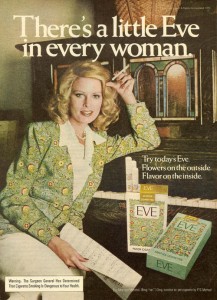
Tobacco companies continue to market cigarettes like the brand Eve to women by associating smoking with an image of liberation, autonomy and even sexual independence and pleasure.   Ads like this one for Eve cigarettes seem ludicrous given the known hazards of smoking, a habit anything but liberating or sexy.    

By and large, women simply know better now and view this corporate targeting of girls and young women for self-destructive consumption as offensive.

Or have we learned lessons from the tobacco industry’s lucrative exploitation of women?

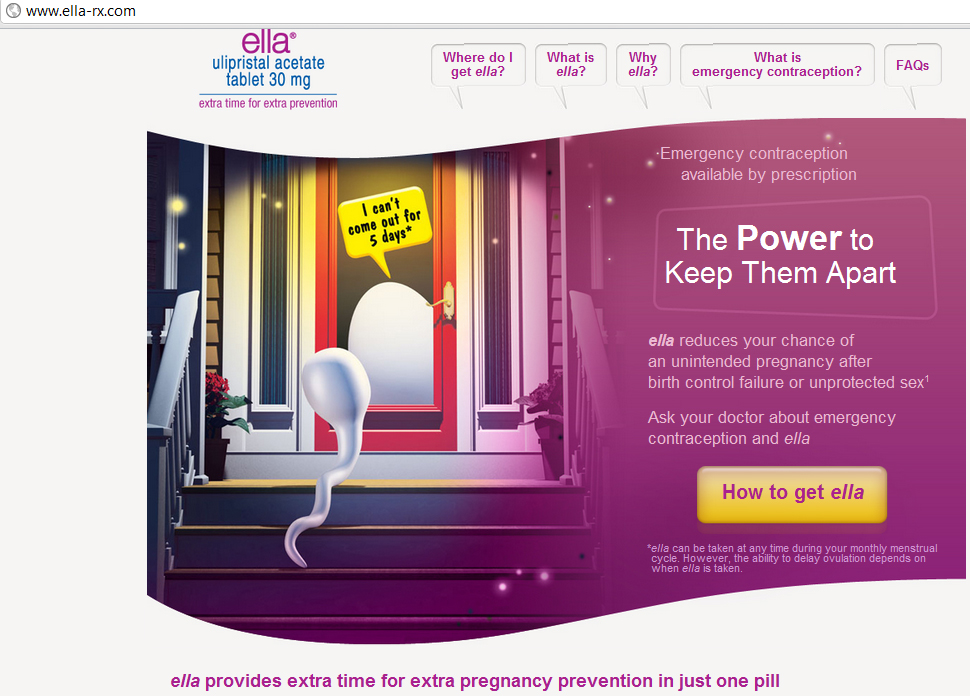
Take Ella for example.  Watson Pharmaceuticals markets and sells Ella as an oral medication which, taken within 5 days of sexual intercourse, effectively disrupts or prevents pregnancy. 

EllaOne tablets contain the active ingredient ulipristal acetate, which is a selective progesterone receptor modulator.  It works by acting on the body’s receptors for the naturally occurring female sex hormone, progesterone. It is not fully understood how this medicine prevents pregnancy. It is thought to work by preventing ovulation and fertilisation and also by altering the lining of the womb, depending on which stage of the menstrual cycle the woman is at.

One dose of this “hormonal inhibitor” can cause nausea and vomiting, dizziness and headache, abdominal and menstrual pain, as well as tiredness and mood swings.  More rarely reported side effects include kidney problems.   

The dose sells for approximately $40.  

Watson Pharma is anxious to develop and tap the female market on this product which promises a veritable treasure chest of cash.  Consider the short history of Ella’s cousin, Plan B, another “morning after” pill.

The popularity of the morning-after pill Plan B has surged in the year since the federal government approved the sale of the controversial emergency contraceptive without a prescription.  Plan B sales have doubled since the Food and Drug Administration authorized the switch for women 18 and older last August, rising from about $40 million a year to what will probably be close to $80 million for 2007, according to Barr Pharmaceuticals, which makes Plan B.

From the experience with female-targeted tobacco, women should fairly be asking a range of questions about this medication:  How does it work?  What affects does it have on my body?  Are there long term consequences to using one, two, three, even more, doses of Ella?  Can I get cancers or other diseases from using Ella?  Can Ella impact my future health, including my future fertility?  How does my access to, and use of, this drug impact my sexual partner, my sexual outlook and my emotional health?  Will I be more vulnerable to STDs?  Will Ella improve my sexual autonomy and control as promoted in its advertising?

The immediate objection to the Ella-Eve comparison is that the U.S. Federal Drug Administration has approved the use of Ella as “safe” – while the U.S. Surgeon General continues efforts to convince the public that cigarette smoking is “unsafe.”  Women want to believe that the government – and its stamp of approval – offers the singularly significant reassurance to the female market that the product will not harm them and that women do not have to think about these questions. 

But the FDA’s imprimatur is anything but convincing.  Here’s the undisputed reality: 

1. “It would be fair to say that EllaOne is so new that not a lot is known about its mode of action, or possible long-term effects.”  “The manufacturers say that it ‘is thought to work by stopping your ovaries from releasing an egg’. They also state that ‘it may also alter the environment in the womb’.”

2.  “There are no long-term studies on the safety of [morning after medications] in women under 17, after repeated use or effects on future fertility.”

3.   “Ella should not be taken if you are already pregnant.  There is little information on whether Ella would harm a developing baby.”

4.  “Using ella may make your regular hormonal birth control method less effective.”

5.  Ella provides no protection against sexually transmitted diseases.

What is the import of this reality?  This means that the FDA approval of the use of Ella is akin to approving smoking an occasional Eve cigarette – but even that single use may result in significant consequences, including impacting a current pregnancy and increasing likelihood of an unintended pregnancy and exposure to STDs.

The “unknowns” about Ella, like the unknowns about tobacco, have not slowed Watson Pharmaceuticals’ effort to convince females that Ella will keep their romantic sex-life healthy and happy while insuring their “eggs” do not go out to “play” with the sperm searching for its own “date”.  Their website features a handy “refer a friend” automated, personalized email feature so that girls and women can spread the word and enlarge the market.

Ella may, in time, prove to be an acceptable drug with no long term, deleterious impact on women’s health or the environment.  Or, once studied and understood, it may prove to a profoundly profitable pursuit targeting, creating and cultivating a female market upon which the long term health and even environmental consequences will prove dire – like cigarettes.   Is Ella an Eve in disguise?  It’s impossible to say – but it is not impossible to discuss if women of all faiths and political stripes would put down their agendas and talk about Ella the way we all talk about Eve. 


Talk About Eve

Why do women today reject tobacco products that pollute air and body while embracing hormonal products arguably as harmful? 

I suggest we talk about fertility controlling drugs like “Ella” with the same concerns and skepticism we discuss tobacco products like “Eve” – both products targeting females to create market demand among girls and young women.  In today’s post, I look at the development, sales and marketing of cigarettes, like Eve, and how women learned that, despite serious health consequences, they had been manipulated and duped into smoking.  Tomorrow, I will explain why we should be talking about products like Ella, a “morning after” pill, with the concerns and skepticism we learned from our disastrous experience with tobacco.  

Since 1971, when the Liggett Group introduced the demurely named “Eve” line of cigarettes, some number of women have inhaled enough designer smoke into their lungs that they are now dead.  They have died from the cancers, heart disease and strokes associated with prolonged use of nicotine.  Since 1971, men, women and children who enjoyed the company of the now deceased Eve smokers have suffered discomforts and aggravated conditions breathing the very feminine Eve smoke blown their way.  

We all regard the imagery used to sell Eve cynically.  There is nothing feminine in a smoker’s cough or nicotine addiction, any more than a well dressed corpse wearing cute, tidy Tods.  We know this because of the tireless and focused efforts of thousands of tobacco opponents who, using media, litigation and advocacy, have exposed the shameless marketing techniques of “engineered consent.”  Creating demand among women by associating products with female liberation, independence and autonomy distracts from and neutralizes the (now) well known long term consequences of smoking. 

The market for female-targeted cigarettes – like Eve – was first engineered when long term health and environmental consequences of smoking were unstudied and undocumented.  Tobacco companies continued to develop the market even as they ignored, denied and then concealed smoking’s long term impacts.  Author Allan Brandt has chronicled the industry’s lucrative success in coaxing females to choose smoking. 

Many would link cigarettes with a new sexual accessibility among adolescent women, a marker of independence and autonomy . . . a symbol of beauty, glamour, and sexuality for women.  Women at colleges and universities quickly became committed to the important meanings the cigarette conveyed about them.  Smoking became a “choice” and a powerful symbol of breaking with convention. 

Eventually, social policy took notice of both the long term consequences of smoking and the marketing stunts of tobacco companies.  While unable to illegalize smoking, social policies and initiatives developed to severely disfavor the “choice” to smoke, using steep taxes and graphic warnings while also tightly restricting smoking in public as well as advertising. 

Today, a woman can choose to smoke, but she does so at substantial expense and fully informed that she places her future health and quality of life at risk.  Society frowns upon – even shames – her choice to smoke for its impact on her health as well as the impact on the larger environment.

Many of us who grew up as the dangers and deceit of Eve were stubbornly and slowly exposed now marvel at women’s willingness to ingest hormone-tampering drugs – like the morning after pill Ella.  Are these “liberating” sex-promoting, hormonal products – some of which are “as easy (for women over 17) [to obtain], as say, buying cigarettes” – the female nicotine of the 21st Century?   There are critical questions to ask and answer as girls and young women are vigorously targeted as a developing market much the way tobacco companies targeted and developed a market in cigarette smoking.  Indeed, the female-targeted pharmeceutical market is poised to explode.

Hormonally-based, fertility controlling drugs may become even easier to get than cigarettes as drug companies convince government to mandate their availability to women free of charge

In tomorrow’s post, I propose that we apply the lessons learned from “the glamour and autonomy” of female-targeted cigarettes to the developing, hot market for “sexually liberating” hormone-tampering drugs like Ella.  Just how much do we actually know about the impact of these new drugs – marketed to promote independence and power in a woman’s sex life – on a women’s long term health and on the health of the environment?

Religious Convictions

Stand Up for Religious Freedom San Francisco rally took place on Friday, March 23 at the Federal Building Plaza.  It was one of the 140 rallies held on Friday across the country, coast to coast.  Armed with copies of the Women Speak for Themselves open letter to President Obama, Michele Coldiron and her fellow New Feminists gathered over 250 signatures.  I spoke at the rally and offered the New Feminist perspective on the HHS mandate.

Good afternoon everyone! I am here to talk to you as a FEMINIST.

I am a lawyer and a feminist:  a New Feminist.  I come from a long line of authentic feminists who caused change in this country: ending slavery and child labor, treating the poor with compassion, securing the right to vote for women. 

These authentic feminists caused change because of their religious convictions.  Susan B. Anthony fought for the right of women to vote from her religious conviction that God gave women the same dignity as men. Katharine Drexel fought racism and the Ku Klux Klan from a religious conviction that God made all persons with equal dignity. 

I could stand here all day and go through long list of women who changed this country because they acted upon their religious convictions.  These are women – like all of the women here today – who say, “I cannot just sit around and talk about my religious convictions.  That’s ridiculous.”  Religious conviction without action, without the right to act upon it, is hot air.

President Obama wants to take away the right to act, the right of Catholics and people of faith to act upon their religious convictions regarding abortion and contraception.  He wants the Catholics to go to the back of the bus and stay there.  He wants them to stay in the back of the bus and chat among themselves.     

I am a Catholic and I do not want to go to the back of the bus.  I don’t want my bus fare to pay for abortions and contraception that I know are bad for women, men, children and families.  I know these are wrong through my religious convictions. 

You may not agree with me about my religious convictions, but I think you will agree that I have a right to say so and to act upon my religious convictions.

President Obama and Secretary Sebelius think my religious convictions on these issues are nothing but hot air.  They should know better.  They should remember Rosa Parks.  In 1955, Rosa Parks refused to stay in the back of the bus.  She was a woman of religious conviction and action.

One day Rosa Parks said, “No, I will not go to the back of the bus today.  I will never go to the back of the bus again.” 

Every woman here today, every single one of you is just like Rosa Parks.  We are women like Rosa Parks and we are sitting down in the front of the bus today. We are demanding our right to act upon our religious convictions. 

Being here today means you are a woman of action and a woman of faith. Nearly 25,000 women of action and women of faith have signed a letter to President Obama demanding our rights to practice our faith in public.  We want you to join us and sign the letter.  There are women in the crowd who can give you a copy of the letter and take your signature.  Or you can go to www.WomenSpeakForThemselves.org and sign the letter.

It’s short and sweet and to the point. 

We are women who support the competing voice offered by Catholic institutions on matters of sex, marriage and family life. Most of us are Catholic, but some are not. We are Democrats, Republicans and Independents. Many, at some point in our careers, have worked for a Catholic institution. We are proud to have been part of the religious mission of that school, or hospital, or social service organization. We are proud to have been associated not only with the work Catholic institutions perform in the community – particularly for the most vulnerable — but also with the shared sense of purpose found among colleagues who chose their job because, in a religious institution, a job is always also a vocation.

Those currently invoking “women’s health” in an attempt to shout down anyone who disagrees with forcing religious institutions or individuals to violate deeply held beliefs are more than a little mistaken, and more than a little dishonest. Even setting aside their simplistic equation of “costless” birth control with “equality,” note that they have never responded to the large body of scholarly research indicating that many forms of contraception have serious side effects, or that some forms act at some times to destroy embryos, or that government contraceptive programs inevitably change the sex, dating and marriage markets in ways that lead to more empty sex, more non-marital births and more abortions. It is women who suffer disproportionately when these things happen.

No one speaks for all women on these issues. Those who purport to do so are simply attempting to deflect attention from the serious religious liberty issues currently at stake. Each of us, Catholic or not, is proud to stand with the Catholic Church and its rich, life-affirming teachings on sex, marriage and family life. We call on President Obama and our Representatives in Congress to allow religious institutions and individuals to continue to witness to their faiths in all their fullness.

Please join us.  Please sign this letter.  Refuse to take your religious convictions to the back of President Obama’s bus.

Can Feminists Dialogue? ~Pt. 2

I continue my post whether Feminists can dialogue from yesterday, when I described, I hope fairly, Trend One, Progressive Feminists. 

Trend Two, New Feminists.  Here fall many women who have taken birth control pills, had abortions, practiced promiscuity, marched, screamed and shouted at sexist, porker pigs – and then changed their minds, reemerging as New Feminists.  Many of us are so similar to Trend One women in education, background, experience and privilege that no demographic can sort us neatly.  Trend Two includes women who did not go the route of Progressive Feminist but who have appreciated and defended many of the legal and cultural achievements of the original American feminists, and who were not side tracked by agendas to neutralize, denigrate or, now, commoditize women’s fertility and the mother-child relationship.

Some Trend Two women have reported religious conversions or experiences that resolved anger or dissonance.  Others have concluded that Mother Nature had a far greater hand in creating differences between the sexes than could fairly be blamed upon sexist, porker pigs and that the progressive feminist movement had become oddly determined to make women into better men than men.  Many Trend Two women object that girls and young women are being encouraged in lifestyles and choices that lead to emotional and physical illnesses later in life.  Trend Two women often say that they could no longer pretend that a tiny fetus with a beating heart was not a child; and that being a mother and wife brought out very powerful feminine attributes that benefit all of humanity.  

Some Trend Two women parted company with Trend One thinking to resolve a nagging discomfort with moral relativism – a relativism that seems to threaten humanity with a pre-modern domination by a superior, worthier class. This blog, www.NewFeminism.co, for example, is dedicated to such a Trend Two woman, Elizabeth Fox-Genovese.  Professor Fox-Genovese wrote of her own taking leave with her Trend One senses,

[M]y commitment to women’s right to develop their talents predisposed me to support the legality of abortion, at least up to a certain point. Even then, I found it impossible not to take seriously the life of the fetus that was being so casually cast aside. The emerging discussions of assisted suicide only intensified my discomfort, as I found myself worrying about one human being deciding whether another’s life is worth living. “How do we know?” I kept asking myself. “How ever can we know?”

An interesting example of a Trend Two woman is the wife of Kelly’s “Mad Man”, jerk and dinosaur, Rick Santorum.  That “wife” is actually a well educated woman whose life and background speak volumes about the assumptions still driving Trend One passions.  Subject of a recent Trend One hit piece by Nancy Hass, it turns out the Karen Garvey Santorum was once pro-choice and progressive, the live-in girlfriend of a Pittsburgh abortionist.  In a more thoughtful consideration of her rejection of both abortion and the abortionist she lived with, and her decision to embrace an orthodox Catholic lifestyle, the New York Times set Ms. Garvey’s transformation in the complex relational context that have lead many Trend One women to question, and even abandon, the basic Trend One assumption that unrestricted individualism offers the primary path of female fulfillment.  That context included meeting and falling in love with Rick Santorum who, himself, was not practicing religion at the time or asserting the conservative positions that would emerge from his partnership and marriage with Ms. Garvey.

> > > > > >

I can count among prominent women leadership in America today dozens of Trend Two women, running nonprofits, winning political office, writing and speaking on social issues facing women.  Steadily the voices of Trend Two women are being raised in search of policies that preserve feminine qualities, protect the unique role of women within families and regard female fertlity – and the female body – as worthy of protection as the environment itself.  

It is unsettling that the greatest opposition and scorn to women’s “new” feminism voices come from other women.

The lack of nuance and basic respect by Trend One commentators toward “Beatrices” (see yesterday’s post), non-Western (often religious) women and women who question Trend One assumptions, brings to mind a note our daughter once received from the “most popular” girl in the 6th grade class of her new school.  The note read:

You’ve been here 2 months.  It’s almost Christmas break.  You need to know that me and my friends do not like you.

The prevailing Trend One message is equally transparent:  the “Beatrices” of the world – no matter how faithful and loyal in their work and families – as well as Trend Two women – no matter how educated or accomplished – know that Trend One women do not “like” any us.  Trend Two women have been criticized, snubbed, yelled at and called rather vicious names, often on the Internet and in public – often by people who we thought once were friends.  It’s a stark fact that Trend Two women, New Feminists, often raise their questions and concerns at the cost of friendships and professional relationships they held dear. 

That, however, does not change our experiences and our wish that Trend One women would stop blaming a vast right wing conspiracy of Alpha males for opinions that are originating and resonating with other women.  Trend Two women invite Trend One women to step up to the pressing need for dialogue among women, about women.  We could start, for example, with the elimination of girls through abortion worldwide.  

So I ask again, can women with deep differences dialogue respectfully?