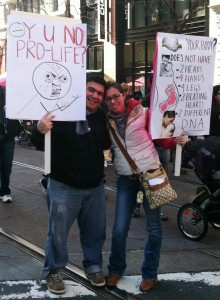
Stop Surrogacy Now!

An important new campaign launched on Mother’s Day. I am a signatory to petition. Will you join us?

Stop Surrogacy Now Launched

Worldwide Coalition to End Surrogacy and the Exploitation of Women and Children

San Francisco, CA/May 11, 2015Stop Surrogacy Now launches today. Stop Surrogacy Now brings together a worldwide, ethnically, religiously, and culturally diverse group opposed to the exploitation of women and the human trafficking of children through surrogacy.

Deutsche
English
Français
Svenska

With support from 16 organizations and more than 100 individuals from 18 countries, Stop Surrogacy Nowdemands recognition that surrogacy exploits women (in many cases poor and marginalized) who are paid to bear children. Often these women are subject to coercion, restrictive or substandard living conditions, and poor health care. In addition, surrogacy carries many severe, short- and long-term health risks. Many surrogates live as indentured persons with 24 hour monitoring of the “property” within their wombs.

Stop Surrogacy Now demands recognition that children conceived for surrogacy are quality-controlled: subject to sex-selection or abandonment for disability or simple change-of-mind. Children produced through surrogacy are objects of contract as well as products of inequitable bargaining power and unregulated markets. Most often, these commercially produced children experience the sudden and complete severance of the natural bond between mother and child and are intentionally deprived of contact with and knowledge of one or both biological parents in direct violation of the U.N.’s Declaration of the Rights of the Child.

Signatories to Stop Surrogacy Now demand a complete stop to surrogacy in order to protect women and children worldwide and to end efforts that would seek to legitimize and normalize trafficking children.

“A woman is a human being not a machine, states Shagufta Omar, President, Pakistan Chapter of the International Muslim Women Union. She continues, “Disconnecting both mother and the child from each other is the violation of the human rights of both.”

“There is no right to a child and rich people must be stopped from using a woman as a living incubator and then taking their baby away and showing it off as their own. We must prevent this reproductive slavery and stop it now”, says Dr. Renate Klein, long-time health activist and FINRRAGE (Australia) co-ordinator.

Among the 16 organizations joining the Stop Surrogacy Now campaign is CoRP, a French NGO that promotes human rights and the abolition of surrogacy as being in contradiction to international conventions such as Article 21 of the Council of Europe Convention on Human Rights and Biomedicine, the so-called Oviedo Convention, which stipulates, “The human body and its parts shall not, as such, give rise to financial gain.”

Dr. Mia Fahlen of Sweden states, “I’m joining this campaign to fight surrogacy to combat the exploitation of women all over the world. The ethical, medical and psychological consequences are far greater than thus far have been recognized.”

We invite everyone to join us and add their signature in support of the Stop Surrogacy Now campaign.

Walk for Life West Coast 2015

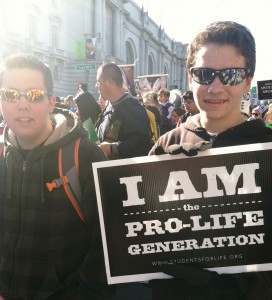
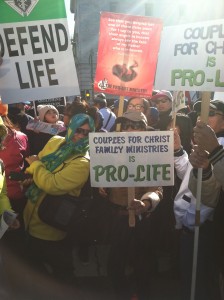
Under beautiful blue skies, the 2015 West Coast Walk for Life took off from City Hall.  Like last year, the walk rambled along Market Street from Civic Center Plaza to Justin Herman Plaza at a lazy, happy pace. While the signs tell the story of the march – why people came and their sentiments – three new features stood out this year.

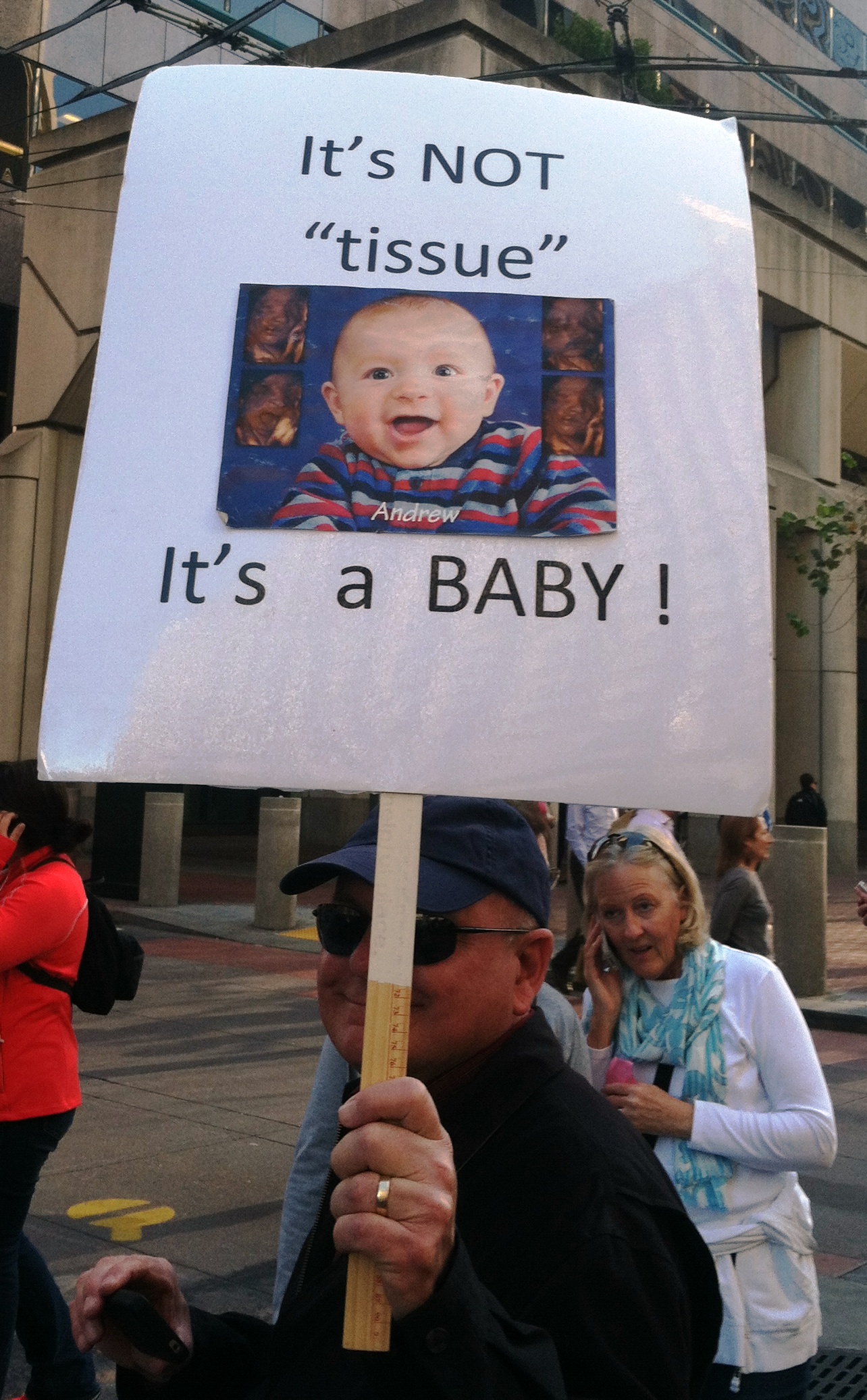
First, the march was more joyful and “happy-faced” than ever, including an anti-abortion secular contingent. Second, the technology allowing us to see unborn babies has made it’s way into the parade for life. Third, the pro-abortion voice has reached new levels, openly advocating for the abortion of all babies to “save the planet.”

Let’s start with my favorite sign this year. Thanks to Amelia for making and posing with her poster. Awesome Amelia.

IMG_0026_2

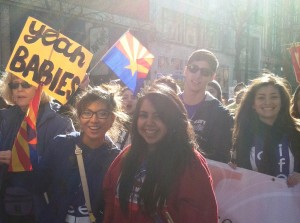
We’ve all been in marches but our Walk for Life West Coast has become a fun and joyful event. This year, yellow balloons, happy faces and a very youthful crowd created a festive atmosphere.

IMG_0037 IMG_0179_2 IMG_0165

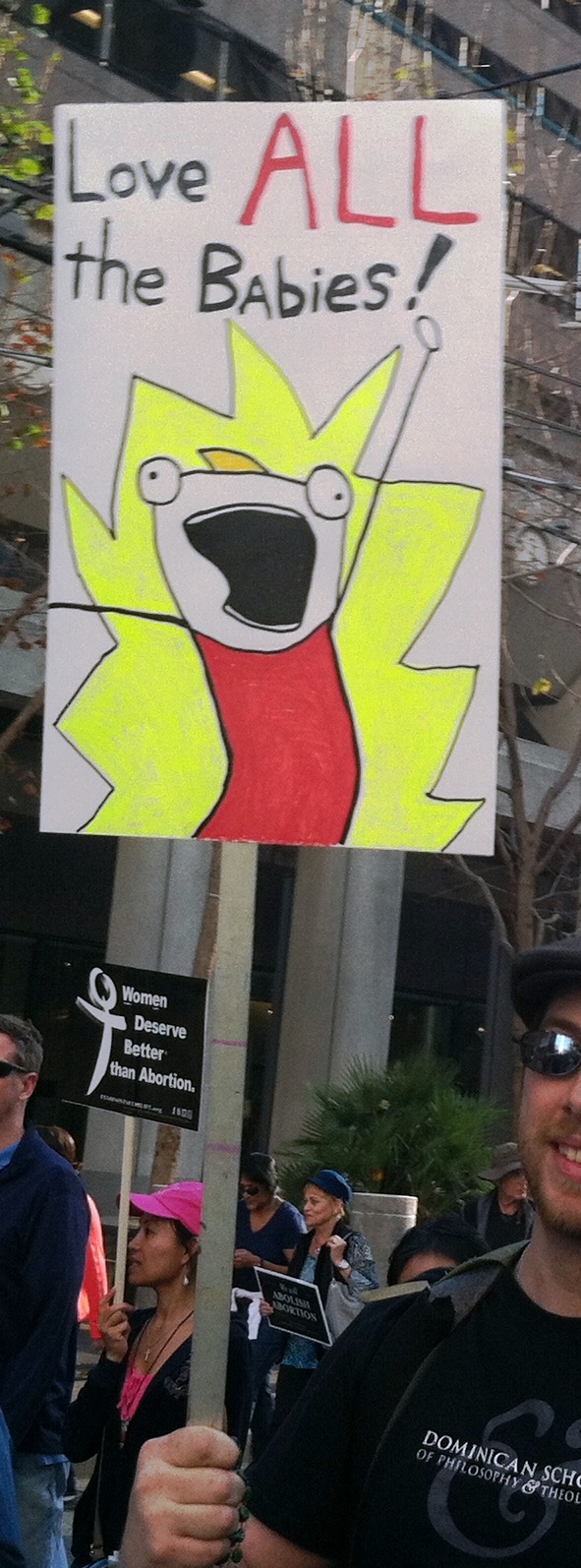
While the pro-life movement is often associated with religious orientation in the media, Feminists for Life – which originated the slogan “Women Deserve Better” – has always opposed abortion, following in the steps of the original feminists. This year, SecularProLife.com made its presence known.

IMG_0084 And this T-shirt told the abortion story in terms familiar from childhood tales.

IMG_0098_2 IMG_0096

Many walkers came in groups, with their own custom T-shirts, prayers or music.

IMG_0158

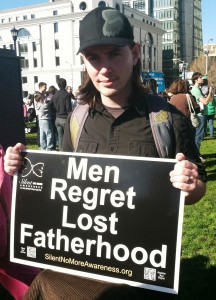
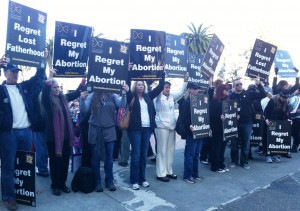
IMG_0022_2 IMG_0102Women who regretted their abortions came to say so, just as fathers grieved lost fatherhood.

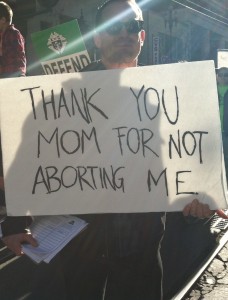
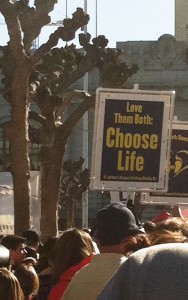
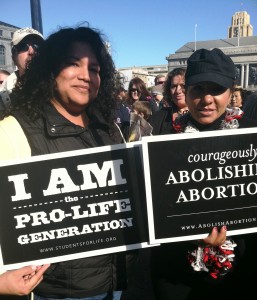
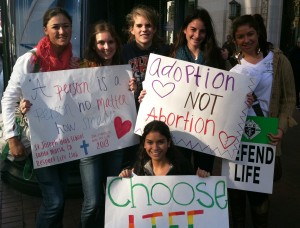
IMG_0161 IMG_0142_2I liked the homemade signs. They seem to come from the heart.

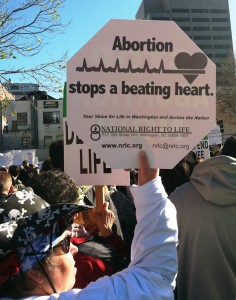
IMG_0141_2 IMG_0107 IMG_0050Despite the science, abortion proponents insist that “fetuses” are not human, not babies, not children, not people – a category of life with no rights, protection or value.

IMG_0117_2 IMG_0075But Amelia did not think so. Pro-life signs asserted the dignity – and rights – of the silent unborn.

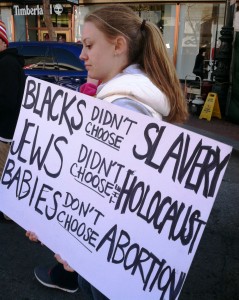
IMG_0095 IMG_0160_2 IMG_0077 IMG_0072Historical perspective was offered.

IMG_0127_2IMG_0036

In the hot spots along the route, order was maintained by the dedicated San Francisco Police.

IMG_0134 IMG_0132

As the Walk has grown and become safer over the years, the crowd has swelled with young adults, teens and children.

IMG_0163 IMG_0151_2 IMG_0143

Yet, on the edges, advocacy for death howls. This year, for the first time, one protestor called for the death of all babies – to save the planet. Isn’t this “hate speech”?

IMG_0043 What a contrast to the Culture of Life – darkness and light side by side on Market Street in San Francisco.

IMG_0173 IMG_0171 We reached the end of the Walk happy to see signs for … logistics.

IMG_0140

Happy to see media coverage.

IMG_0138 IMG_0101 IMG_0073

Happy to pass through the end of Walk balloon arch – where the determined pro-life youth linked arms to buffer the last ditch efforts of the opposition. Frankly, I could not hear the opposition over the “pro-life” chant of these young adults.

IMG_0127_2 IMG_0135It was a day to walk in favor of life.

IMG_0104_2In favor of life.

IMG_0023

In favor of life.

IMG_0059

In favor of life – an idea expressed now for 11 years … but just this year, covered by NBC. 

And so … the Walk goes on.


Fox-Genovese: Abortion

On January 2, 2007, Elizabeth Fox-Genovese, to whom this site NewFeminism.co is dedicated, died at age 65 after a long battle with multiple sclerosis. Her husband, Eugene Genovese, outlived her, dying on September 26, 2012 at age 82.  As far as I can determine, the elder Genovese wrote and published only one work of his own in the five and a half years he lived without his beloved wife – a slim, eloquent volume entitled Miss Betsey: A Memoir of Marriage. The cover photo of that book invites the reader to his tale of romantic devotion, surprising conversion and academic intrigue, told by the survivor of this highly visible – and controversial – intertwined pair of academics.

fox-genoveses

Genovese did not write about his marriage in order to share memories with their children – they had none.  Nor did Genovese seek to memorialize his wife’s thoughts – this she had ably done. (See, for example, the 5 Volume collection, History & Women, Culture & Faith: Selected Writings of Elizabeth Fox-Genovese). Rather, when she died, Genovese “felt driven to write about the life of a woman who led me out of the slough of despond and provided the loving home I wanted and badly needed.” (p.3) Genovese wrote of his beloved wife, it seems, more as an exercise to understand his own life, a life “split in two: Before Betsey and Since Betsey” – a life he had always hoped to have but found in Betsey “by the grace of God.” (p 2).

It is in this context that Genovese reflects on one of the more controversial developments in his wife’s thinking, when she decided she could no longer present herself “pro-choice” on abortion and, as a result, became target for the bitter backbite of fellow feminists and intellectuals.  But what Genovese found remarkable in his wife, her passion for unadorned truth and her love and compassion for women as women, has established a foundation upon which New Feminism continues to grow and flourish.

*     *     *     *     *     *

Abortion had always made Betsey queasy.  For years she remained sufficiently attached to the feminist movement to persuade herself to support “free choice” during the first trimester and with such limitations as parental consent and absolute denial of partial-birth abortion. She supported such “compromise” largely because she considered it the best politically available alternative to an incipient civil war.  She gagged on abortion for a simple reason: She knew, as everyone knows, that an abortion kills a baby. Betsey responded with incredulity to the argument that the baby a woman carries in her womb is not a baby at all or, alternatively, that although it is a baby, her mother has a moral and constitutional right to kill her. And Betsey resented the denigration of women implicit in the “pro-choice” campaign. Years later, in the private journal she kept as she entered the Church, she wrote:

Paradox: intent of abortion has been to free women, but it has imprisoned them. Anima Christi: soul and body are one, not two. Abortion devalues and debases woman’s bodies – strips them of their character as Temples of the Holy Spirit.  Abortion has not heightened respect for woman’s bodies, but only confirmed their status as objects to be used.

A related matter went down hard with her. We hear all the time that retarded and deformed children should never have been born – that their lives should have been snuffed out by parents and doctors sensitive to the “quality of life.” Betsey did not take well to people who claimed the privilege of judging who deserved to live and who ought to be put to death. Again, as a Jew aware of the underlying ideology of the Holocaust, she had no tolerance for people who claimed the right to dispose of human life in accordance with whatever sick creed they were espousing. Over the years, she met a number of retarded and autistic children. None struck her as floating miserably in a life without pleasure. Betsey saw for herself that, however painful their daily experiences, they awoke every morning secure in the knowledge that their parents loved them, considering them gifts from God.

The radical feminists’ assertion that a woman has absolute property in her own body provoked mirth from those who, like Betsey, knew that the modern Left had arisen to oppose the bourgeois theory of absolute property in anything. Betsey steadily hardened her line against abortion while she maintained unsparing compassion for the unmarried young or poor pregnant women who felt trapped. She spent years as a volunteer in community groups that cared for pregnant teenagers, poor mothers and their children, and battered wives.

On these matters, as in others, she had special powers of persuasion. I caught a glimpse of her ability to touch an audience in January 2005 – less than two years before she died. I attended her lecture on abortion at Hamilton College in New York. She had been invited by the small conservative student contingent, but she faced a large and largely skeptical audience. Once again, I thought she might have spoken in a livelier fashion; once again, she refused to indulge rhetorical tricks or cheap shots, much less talk down to students. She took up the major arguments, pro and con. Calmly, she reviewed moral, statistical, and other evidence and dug into the implications and ramifications of the slaughter of millions of infants. I watched the students closely. Apparently, most did not support her pro-life position, yet they hung on her every word. She may not have convinced many, but she clearly made them thoughtful. And they responded respectfully. It was obvious that their radical feminist professors had not deigned to introduce them to the pro-life side, so that they might “choose” between the alternatives. As the students left the hall, they did not disguise their admiration for Betsey’s presentation and replies to hard questions. They also made clear that they were not amused at their professors’ efforts to shut them out from an opportunity to consider pro-life views.

*     *     *     *     *     *

Miss Betsey: A Memoir of Marriage is available in hardcover.

Signs: Walk for Life West Coast 2014

A massive and diverse crowd of protesters rallied in front of [San Francisco] City Hall before marching down Market Street to Justin Herman Plaza for the 10th annual “Walk for Life West Coast.” They chanted “Pro Life” and carried signs that read “Defend Life” and “Women deserve better than abortion.” San Francisco police did not immediately provide an official crowd estimate, but at one point marchers stretched across more than a mile of Market Street, the liberal city’s main thoroughfare.”

The size, energy, youthfulness and enthusiasm of this now-entrenched San Francisco event grows each year. Most remarkable to us New Feminists who have participated in this walk over the years is the disappearing presence of counter-protesters who, in the early years, threw red-water balloons, barricaded passage and thrust coat hangers as they angrily taunted us walkers – many of whom quietly prayed and pushed baby strollers.

Opponents to the pro-life presence in San Francisco sought to frighten, bully and shame those they defined as enemies – enemies of women. But it’s hard to sustain a movement fueled by anger and hostility – especially when directed at babies, families and peaceful people who value all lives. It’s hard to motivate people to spend their Saturday jeering and accosting elderly people walking with their grandchildren, devoted parents pushing disabled loved ones confined to wheelchairs and exuberant young throngs happy to be alive and celebrate life. Feminism was never intended to be a movement of angry women bent on creating options to destroy and eliminate “burdensome” lives. Feminism was born from women’s determination and passion for having a voice in nurturing, valuing and protecting all lives.

New Feminism – women celebrating life and their role in nurturing and protecting all life – was on beautiful display yesterday under sunny skies. The air literally sizzled with joy, happiness and gratitude. The occasional angry person shouting for “abortion without apology” seemed more akin to the city’s mentally ill homeless people than people with a considered point of view.  In a such a joyous crowd, anger seems sad, pathetic. I was nearly tempted to offer a hug.

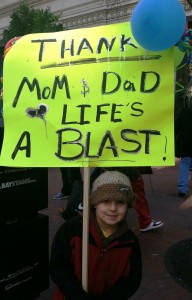
But the West Coast Walk for Life is no longer about pro-life opposition. It’s about the celebration of life by diverse people with both religious and secular appreciation for the unborn – many of whom carried signs personalizing their own reason for participating and celebrating life.

It was the Year of the Sign, 2014.

4

How to hold a sign for several miles is a challenge. Several people can hold the sign high, taking turns.

15

Or you can hold it low and pull it along with your other stuff.

18

You can put the sign around your neck and get your photo taken everytime someone takes a picture of your sign.

16

Or you can attach your sign to the wheelchair so your sign goes where your Grandma goes.

1

You can skip the sign all together and make a shirt with your message.

3

(I’m told Guard Life shirts might be for sale next year!)


11


There are secular pro-lifers – Monica Snyder of http://www.secularprolife.org/ spoke during the pre-walk rally.

6


9


19


There are religious pro-lifers.

5


8


14


But all the pro-lifers are happy.

13

 The bulk of them – the generation of the New Feminist – are young!

17


7


There is always a sign that steals the day. This year, I found two. My final photo here was the last one of the day. I walked back to my car wiping away my own tears of joy and gratitude for the bravery of people who stand with life.  Amazing.

10


2

Yellow Person Program

(This is a parody.  For the original, regarding dogs, see this story, which I have pasted & copied a bit.)

If a Park City Person is decked out in yellow,

please don’t approach.

The Yellow Person Project, new in the community, extends the use of yellow as we know it and identifies persons that need space.  Some people around Park City will be sporting YELLOW to indicate that they need space from other people. Generally, people who have YELLOW bandannas or other yellow accessory items are signalling that they would prefer that you NOT approach them for directions, conversation or chit chat.

An activist has started a Yellow Person Project in Park City, joining a nationwide effort to make people aware that not all persons like to be approached. The Yellow Person Project involves individuals outfitted with yellow scarves as a caution that they might not react well if someone approaches.  300 of the yellow scarves have been donated to the program.  The scarves are available by request locally.

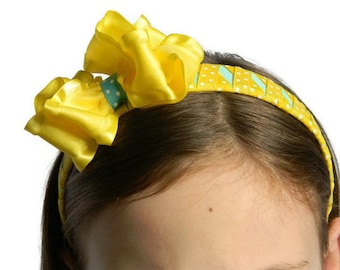
If you’d rather not ask for a yellow bandanna, you can outfit yourself or others with a yellow ribbon, bow or even shoe strings to the same effect.

“I think this problem is all over. People just don’t know when to back off.  It’s time we have a way to send a signal.   I hope this [Yellow Person Program] will reach throughout Summit County,” an official said.

The elected officials listened to a short presentation.  Posters will be put up advertising the Yellow Persons Project. Positive comments about the program are expected.

The trails coordinator at City Hall, told the mayor and City Council that a similar project, the Yellow Dog Project, does not nullify leash laws for dogs with yellow ribbons. In a report to the elected officials, he said City Hall will allow signs to be posted at trail heads and public facilities about all this new use of yellow.

“It’s really an extension of yellow as we know it,” one official said.  “Yellow lights mean it’s time to stop now because, hey, next is red.  So, yellow scarves and accessories are just the same darn thing.  Slow down there, you, and stop.  Don’t cross my intersection, my man. It’s a beautiful warning system and I am proud to back it.”

Advocacy groups have said they support the natural, organic extension of the use of yellow and will promote both programs, indicating that the government will find broad support throughout Summit County for the Yellow Person and Yellow Dog Project as well. There have already been a few signs spotted in the community advertising at least one of the programs.

The original Yellow Dog Project is used by people in 47 countries, according to the organization’s website. It is described as a program meant to caution people that dogs wearing the yellow may need more space than is typical. The dogs might be in training, recovering from surgery or in rehabilitation, the website says.

The program was recently adapted to persons, who, like dogs, may need more space than is typical.  The person might be on medication, recovering from surgery, in crisis or otherwise generally hostile toward other human beings and unable to interact easily and comfortably with other persons or not-yellow dogs.

It is important to note that persons or dogs wearing yellow bandannas are not necessarily aggressive, but they “don’t really welcome interaction.”

So, just leave them alone.


Umbrellas, Boobs & Bad Ass Mohawks

The recent flurry of critical commentary provoked by the photo featured here set my New Feminist nerves on edge. What could possibly be wrong with a US Marine detailed to the White House holding an umbrella for the President of the United States?

The real story is not in the photo.  It’s in the Marine Corps regulations.  Umbrellas, it seems, are for females. Male marines are instructed,, “never to carry an umbrella from the earliest phases of training.” Female marines, however, are allowed limited use of regulation umbrellas “during inclement weather.” There is unquestionably a gender specific “double standard” in the US Marine Corps when it comes to umbrellas and, like any gender differentiation these days, we are not suppose to mention these differences in politically correct company. Blathering is often a telltale sign of an underlying gender issue. I’ll get back to this.

The photo itself seemed remarkable to me, not as a breach of military uniform policy, but for the utterly amazing umbrella-holding technique demonstrated by the buff US Marine, 25 year old Nathan Previti. This fellow has clearly practiced holding an umbrella so that he looks terrific in a photo of himself holding an umbrella, even though he is standing out in the rain and has his arm in exactly the same position bad boys in my 7th grade class had to balance a telephone book when Mr. Bailey got very pissed off at them.  I mean, could anyone possibly look more competent and in charge of an umbrella than Marine Previti?

Frankly, I would let this Marine hold my umbrella anytime.  Most men are pretty good at positioning the umbrella over their own heads, but negotiating where to put the umbrella to keep another person dry, is not normally in their umbrella skill set.  Most fellows end up badly miscalculating the direction of the wind and the rain and you end up getting drenched.  It’s better to have no umbrella holder than a poorly trained one like this useless fellow – which is to say that handling an umbrella for someone else is not all that easy.

But most of the social noise about President Obama and Marine Previti utterly ignored umbrella-holding technique and, instead, focused on Marine Corps Uniform Regulation 3035 which provides:

3035. UMBRELLAS (Female Marines). Female Marines may carry an all-black, plain standard or collapsible umbrella at their option during inclement weather with the service and dress uniforms. It will be carried in the left hand so that the hand salute can be properly rendered. Umbrellas may not be used/carried in formation nor will they be carried with the utility uniform.

From this provision – which “does not expressly [delineate]” umbrellas as authorized for men – one commentator spurred a charge that “The commander in chief of the American armed forces today forced a violation of Marine Corps regulations, so he wouldn’t get wet.”

Reactions (primarily from men) immediately grew emotional, leading Cynthia Enloe, a professor at Clark University, to note, “They seem to be very nervous what constitutes un-manly behavior.”  The fact that the Marine in question was detailed to the White House for service in ceremonial duties which, sometimes, means hoisting and holding steady an umbrella – and looking fabulous while doing so – were facts largely lost in the rising gender jitters.  One (male) writer went so far as to agree that the President had forced a Marine to violate the umbrella regulation but he insisted that the umbrella “rule is dumb,” an example of “macho B.S,” in other words, umbrellas are not just for girls!

Is the gender-specific umbrella double-standard in the US Marine Corps “BS”? Why do different protocols based upon gender make us so nervous we cannot even stay focused on the actual facts at hand? Umbrellas, actually, are only the tip of the Marine Corps iceberg of gender differentiation. A quick glance over the Table of Contents of Chapter 3 of the Marine Corps Uniform Regulations spots subtitles like “cuff link sets (men),” “earrings (women)” “handbag/purse (women)” and “suspenders (men)” in addition to the now well known, “umbrellas (women)”. In fact, from the hair on their heads to the tips of their toes, every US Marine is highly regulated in appearance and choice of attire and accessories and, more, those regulations vary significantly based upon the gender of the Marine.

But allowing variations in gender dress and appearance, is not, in my estimation, the sole reason these differentiations pervade the US Marine uniform regulations.  Rather, I suspect that the regulations actually operate to restrict and prevent much more overt expressions based upon gender which, left to their own choice, US Marines would pursue as readily as civilians.  Notably, rule after rule targeting certain gender specific issues restrict the choices Marines can make in selecting apparel and accessories.  There is no rule, for example, requiring women to wear earrings. But there is a 3 pronged regulation, with sub-parts, describing the size, shape, material and proper fit of permissible earrings if a woman decides to wear earrings.  The many, detailed restrictions on male and females expression of gender in their dress and personal appearance suggests that, even highly disciplined individuals like Marines, can drift toward expression of gender differences to the point of overshadowing the military identity a “uniform” is aimed to cohere.

Here are two examples.

Who can forget this May 2012 photo?

The photographer, Crystal Scott, who organized the photo shoot on the Fairchild Air Force Base and subsequently lost her civilian position on base, planned to feature in a show and posters her photographs of “a pair of Air National Guardsman breastfeeding their children in unbuttoned airman battlefield uniforms.” While the mothers apparently were not disciplined, there was widespread agreement that the photos misused the military uniform by creating an over-the-line, gender specific image in which the gender identity of the women out shadowed their identity as Guardsmen. How remarkably chipper and comfortable these nursing moms seem to be with their boobs on display, literally expressing the life-giving nurture women hold dear, while wearing combat fatigues!  This was an image of “women in uniform” that made even the most supportive “difference” feminists a bit uneasy.

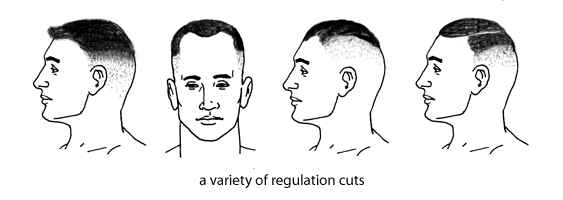
Men just as naturally drift toward unambiguous expressions of their gender identity, given the option.  Consider the resources the US Marine Corps spends devising and educating members on appropriate hair styles.  Women are told cut it short or wear a bun.  Men’s style “short and tight” should be even easier to comply with, right? Apparently not. Bad ass mohawks, for example, are not permitted unless they measure out to the appropriate width of coverage.  Variations like a “horseshoe” or a “teardrop” have all been tried, only to be caught, captured and tossed out.

In case any ambiguity remains, there are detailed drawings of permitted styles available.

Differentiation in permitted hair styles was, incidentally, the first “right” to gender difference litigated after women successfully challenged the male only admissions policy at The Citadel. The “equality means sameness” litigant, Shannon Faulkner, who insisted that the male only admissions policy was discriminatory against women, nevertheless, refused to have her head shaved as required for all incoming cadets. The very same lawyers who had demanded “equality” in the admissions policy became, as New Feminist Elizabeth Fox-Genovese observed, “passionate” about “a woman’s right to have an attractive head of hair.” (Feminism Is Not The Story of My Life, p. 38).

All of which brings us back to umbrellas.

Whether an umbrella, any umbrella, is a unique expression of femininity within Marine culture, I am not sure. What I am certain of is that umbrellas can be, and often are, a fun statement of female sensibilities, both in the use of them to protect against rain and sun and, more, in coordinating them as part of a woman’s statement of feminine fashion.  If you leave it up to us, most women will make a gender statement of some sort with their umbrellas.

Like this:


Or like this:       

Or even like this:

And, well, if we can’t make that feminine statement with our umbrellas then, for most of us, the next best thing would be a well trained umbrella handler, like U.S. Marine Previti for example.  But that takes us to a different topic which I’ll save for another day.  

Whether Regulation 3035 makes sense or not, two things are clear.  Marine Previti did a darn good job with that umbrella when his President called upon him – and he broke no uniform regulation in the process. Second, the Presidential umbrella provoked gender anxiety and I think it is just fine to say so out loud. Some men, it seems, are trying to be heard, in a blathering kind of way, about what they would like to do with that accessory. Sometimes, pictures speak better than words.

Boston Condom

A student from BC – better known as Boston College – paused in front of an informational table set up during the first days of his freshman year. Several pretty girls manned the table, representatives of “BC Students for Sexual Health.” This “BC” – or Boston condom –  organization has made national news as its pretty coeds posed with envelopes of “brightly colored” condoms they insist on distributing “for free” throughout the Catholic campus.  The conversation that day went something like this:

Pretty Girl.  “Hi you.  Welcome to BC.  Are you a freshman? (giggle, giggle)”

Male Subject.  “Well hi there.  (smirk, smirk).  Yea.  I am a freshman.”

Pretty Girl.  “Well, why don’t you join up with us. We promote sexual fun all across campus and we have a sex party this Friday. (giggle, giggle) I can’t tell you just what sex we’ll be doing this week but I promise you’ll have fun. (giggle, giggle)

Male Subject.  “Well, wow. That’s pretty awesome.”

Pretty Girl.  “Well, here’s some information and condoms and, well, you know, (giggle, giggle), please come. (wink, wink)

I heard this story last fall. As a feminist and activist for women, I was dismayed that young women of the caliber and education I assumed Boston College would admit could behave with such triviality. Was the administration not aware of these coquettes operating under the guise of “sexual health?” Did the College realize the image of women, as flirts, sexual objects and pleasure toys, being flaunted and hawked to incoming first year students? I was further dismayed as I explored the girls’ website and discovered how the girls sponsored not classes or educational sessions; rather, they distributed condoms, party kits and literature promoting sport sex along with referrals to Planned Parenthood for the medical services available to treat the various illnesses promiscuity cultivates. Their online freebies even included solo cups!

Throwing a party? Get a Responsible Party Kit from BCSSH! We will provide you solo cups, condoms, and information about safer sex to post in your apartment to help your guests have a safer night.

I felt so ashamed and sad for these girls, who seemed to have no self esteem or sense of the social concern expected of thinking, educated persons, that I contacted the Jesuit college.

Now, the administration of this college has apparently had enough of the Boston Condom campaign to promote sport sex on campus.  Perhaps the college has concluded that passing out free condoms and designating “Safe Sex Sites” – dorm rooms across campus where free condoms (at least) are available when you knock and enter – does not promote safety, health or even common sense – much less the loftier purposes of the institution, “integrating intellectual, personal, ethical, and religious formation; and . . . uniting high academic achievement with service to others.” The college has reminded the girls that the promotion of sport sex on campus is inconsistent with the college’s policies toward the sanctity of life, and has scheduled a meeting with them on April 29 to discuss their condom and sport sex advocacy.  The girls can disagree, of course, but they’ve been asked to respect the college’s policy, the same way the college might reasonably ask student representatives of Altria Group to desist from distributing free purse packs of Virginia Slims.  Girls might insist that the cigarettes show they’ve “come a long way baby” but the college has responsibility to make its own assessment of the consequences of promoting social smoking to women on campus.

Equally disturbing to observers of the Boston Condom campaign is the apparent collapse of feminism on a campus traditionally dedicated to raising the social conscience and awareness of its students within the Jesuit Catholic tradition.  While girls like Chelsea Lennox and Lizzie Jekanowski posed with their condom symbol for a New York Times photographer, testimony unfolded in a Philadelphia courtroom of the brutal murder of live-born infant children.  North Korea sat poised and apparently ready to fire a nuclear warhead.  Efforts to address the violent death of 20 children in a bloody massacre at Sandy Hook Elementary school faltered yet again.  Unidentified persons were executing a plan to detonate IEDs at the Boston Marathon finish line.  And a young woman was found burned and murdered in Jordan, her womb slit open exposing her 4 month old child, in another “honor killing” still practiced against women throughout the world.

The list of atrocities, threats and injustices against women and their children and families could go on and on. Campuses like Boston College have a long tradition of supporting feminists in raising awareness of the continued discrimination and brutality against women throughout the world and in sponsoring clubs and projects aimed at improving the lives of others. The objection of the administration toward the conduct of these girls could fairly arise from their apparent self-absorption with dubious pleasure pursuits and apparent apathy toward real social issues affecting even their local communities. How can these young adults honestly defend the promotion of sport sex as a social concern when the world around them cries out in pain and need? Do they honestly think that their peers deepest needs include free condoms and solo cups – both of which are available within a short stroll to a grocery store or pharmacy? Are these young women oblivious? By their own account, it appears so. As Ms. Lennox told the New Times reporter, she spends her time selecting condoms for her peers.

“We check for the integrity of every package. Everything we make sure is within its expiration date. The package is completely intact. There’s no lube leakage out of anything,” she said with a sheepish laugh.

The college administration is rightfully concerned. These students – who were presumably admitted under high admission standards – have focused their talents and skills and resources not only to promote social sport sex, but, more, to promote an image of BC college students as sexually obsessed, undisciplined and irresponsible.  As the chairwoman Lizzie Jekanowski put it in her interview with the New York Times:

“Students are going to be having sex regardless, and unless they have the education to know that you need to use a condom every time — for pregnancy prevention, S.T.I. prevention — and unless they have them available, they’re not going to use it.”

Ms. Jekanowski’s low assessment of her fellow students, broadcast more in the tradition of commercial sexual services rather than academic excellence, insists that bright, educated young adults have so little control over their sexuality that they cannot acquire condoms for themselves from Planned Parenthood or CVS or other providers.  The sexual impulse, from the Boston Condom perspective, is like a fire, poised to go out of control with damaging consequences unless quickly contained.  Like fire extinguishers hung throughout campus, condoms must be readily available, in easy reach, to grab, open and don lest loosed semen rain ruin within the dorms.

Both fellow students and administrators should find this perspective highly offensive, and, most certainly, inconsistent with a view of the integral formation Boston College values. This is certainly not feminism:  self-aggrandizing through the solicitation and promotion of sport sex runs completely counter to the history and tradition of the feminist movement. That movement, as generations of feminists will attest, seeks to free women from discrimination as sexual, pleasure objects. Its founding mothers launched the liberation of women by their successful demand for the vote, that women could be full participants in improving their communities and the world with the unique voice and vision of the feminine genius.

I applaud the administration for taking this initiative. I hope that the feminists on campus will let their voices be heard and that the coquettish, misguided work of these young women will be challenged and redirected for the wider good. I urge the administration to take back the College back from the Condom, and restore BC’s reputation for fostering concern and action in its gifted students on the challenging and demanding issues facing our world.

Maternal Imperative

Book:  My Sisters The Saints
Author:  Colleen Carroll Campbell (no relation to reviewer)
Publisher:  IMAGE


Have you ever grumbled to yourself, “Is this all there is?  Why does my life feel so empty when I really ought to be grateful and happy?”  You can list your achievements and count your blessings, but, still, a nagging sense of nothingness tugs on your sense of self, and you wonder why, why am I so miserable?

Colleen Carroll Campbell’s spiritual memoir, My Sisters the Saints, now on Virtual Book Tour, opens with the author’s own experience of “nagging discontent” and unfolds a remarkable 15 year, determined journey to find her female self, that “feminine part of me that I thought I had smothered with resumes and credentials.” (79).  My Sisters the Saints offers a ground-breaking view of the challenges facing modern, educated women in discovering their female significance in a culture intentionally designed to measure women like men, by their sexual, material and professional achievements.

Here, we have an accessible, eloquent expression of New Feminism.  Imagine a mix of Betty Freidan’s opportunity-seeking feminism and Caryll Houselander’s female-specific spirituality – utterly opposing views of the feminine and its significance in self-fulfillment.  Campbell charts a very personal, moving struggle through this dichotomy in search of an authentic significance, the sort of peaceful, internal calm which signals a life on track.  In so doing, she discovers that being female is more than biological accident.

Hers was not an easy journey. When Campbell suffered her first bout of malaise, she was already a perfect prototype, a product of the massive, concerted restructuring of female roles and expectations sparked by the 1963 publication of Betty Friedan’s The Feminine Mystique. Campbell’s life was molded and cast to subordinate marriage and family to the career objectives touted and taught by 20th century progressive feminism.   A graduate of Marquette University, a member of the editorial board of the St. Louis Post-Dispatch at age 24, and the only woman of six speech writers to President George W. Bush, Campbell fully embraced the goals and reaped the benefits of progressive feminism. Campbell admits that “feminism . . . was simply the air I breathed as a girl growing up in the 1970s and 1980s and coming of age in the 1990s.”  (5).  Like most young women today, she knew her priority:  “I fiercely guarded my professional achievements as the core of my identity.” (82).

Campbell could not have known, could not have seen, that she came of age in a vast social experiment. Decades before Campbell was born, Friedan herself suffered a hunger for significance. Her emptiness motivated a series of surveys of other women. These women, mostly well-educated, white, suburban housewives like herself, expressed unhappiness in their lifestyle:  “Is this all?” “I feel empty somehow . . . incomplete;”  “I’m so dissatisfied.”  Friedan diagnosed a “feminine mystique” as the cause of this “Problem That Has No Name,” a cultural prison which bound women to mindless domestic roles.  She wrote:

These problems cannot be solved by medicine, or even by psychotherapy.  We need a drastic reshaping of the cultural image of femininity . . .  A massive attempt must be made by educators and parents – and minister, magazine editors, manipulators, guidance counselors – to stop the early-marriage movement, stop girls from growing up wanting to be “just a housewife,” stop it by insisting, with the same attention [given to] . . . boys, that girls develop the resources of self.”  (TFM, 351).

This “drastic reshaping of the cultural image of femininity” proceeded apace, during the years that Colleen Carroll Campbell was born, went to school and came of age as a brilliant, well-educated young woman ready to take on the world in her restructured femininity – that new image of womanhood which sees child-bearing as a biological accident and marriage and domestic interest inferior to traditional masculine measures of achievement.  Combined with the successful promotion of sexual permissiveness, birth control and abortion, progressive feminists have accomplished a massive indoctrination and “re-education” of females to a more “equal . . . image of femininity.” (TFM, 356).  Campbell was exactly the type of new woman progressive feminists sought to manufacture:  women who placed their autonomy and financial and career ambitions at the very core of their identity. 

Now, on the 50th anniversary of The Feminine Mystique, Campbell – a child of the “drastic reshaping” of femininity – has published a new feminist treatise which, like The Feminine Mystique, evolved from Campbell’s own moment of utter disillusionment. In her opening chapter – Party Girl –Campbell writes of the feminist culture bequeathed her:

If the key to my fulfillment as a woman lies in maximizing my sexual allure, racking up professional accomplishments, and indulging my appetites while avoiding commitment, why has following that advice left me dissatisfied?  Why do my friends and I spend so many hours fretting that we are not thin enough, not successful enough, simply not enough?  If this is liberation, why am I so miserable? (5).

For Campbell, the progressive feminist experiment failed. True, she enjoyed its worldly opportunity and freedom to pursue “money, sex, power, and status.”  But the “problem that has no name,” the sinking feeling of insignificance which Friedan insisted would be cured by paychecks and promotions, stirred unabated in Campbell’s “liberated” heart.  She found herself adrift in an increasingly unfulfilling pursuit, without cultural icons or markers to deepen the experience of her life.  Like Wendy Shalit, Carrie Lukas and other brave young women challenging the dishonesty of progressive feminism, Campbell refused to accept the malaise and sought models for “deep-down, joyful peace.”

Where are such models to be found?  The thinning ranks of progressive feminists are disturbingly angry, like Friedan was, referring to themselves as “menopausal warriors” (N. Keenan) and their critics as “anti-feminists.” (S. Coontz).  Increasingly, women of the Baby Boomer generation, my generation, women who themselves have discovered that they are not just the people “who happen to … give birth” and that their “equality and human dignity” are not just functions of earning a paycheck (TFM, 371) are speaking up, refusing to perpetuate the myths which mislead young women like Campbell into masculinized life styles.  As Anne-Marie Slaughter dared to explain when leaving her high level State Department job to spend time with her family:

When I described the choice between my children and my job to Senator Jeanne Shaheen, she said exactly what I felt: “There’s really no choice.” She wasn’t referring to social expectations, but to a maternal imperative felt so deeply that the “choice” is reflexive.

But even with such public admissions, we are a long way from offering detailed guidance to young women for fashioning a workable balance between work and family, much less how to secure a sense of feminine self that feels authentic and significant.

Where can young women turn for understanding and guidance on their inner most longings as women? Campbell turns to a source that has offered a rich tapestry of the “maternal imperative” over the ages.  Whether raised Catholic, as Campbell was, or not, the treasury of the Catholic Church teems with stories of women who found, captured and deployed the “desires that [spring] from a soft, passionate, feminine part” of a woman’s being. (79).  Caryll Houselander once described this vast store of experience and wisdom as “a grandmother . . . with a fortune, indeed, and we dare not miss it; but she certainly has a lot funny old hats and shawls and beliefs and traditions, none of which seem to be fashionable or useful or even wearable.”  (RoG, 92).  It’s a fortune, nonetheless, that represents two thousand years of compiled information by and about women – a fortune amazingly disowned by Friedan feminists as patriarchal, even as they crafted strategies to capture the spoils of the patriarchy they decried.
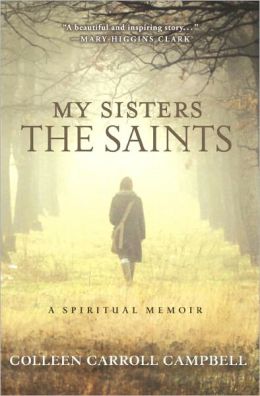
As Campbell journeys in search of her own feminine expression, she discovers and shares the story of six women from her Catholic faith tradition, most of them not biological mothers themselves, but each a saintly expression of the abiding love for humanity so often identified as the natural genius of women. Campbell travels with these women through the small and enormous challenges of daily life:  work-family conflicts, deteriorating illness in a beloved parent, infertility and longings to control and command fulfillment of wishes. Figures like Teresa of Avila, a sixteenth century “party girl with the gift of gab and no shortage of male admirers” (14) and Maria Faustina, “a mousy-looking, barely literate nun,” (65) each become role models, spiritual mentors and true beacons of hope for Campbell as she progresses in her search.

Campbell’s chronicle reminds me of my own gratitude to the women I searched out and found as spiritual guides as I wrestled years ago with my conflict between career and family goals.  Like Campbell, I seemed curiously to cross paths with women just when I most needed them, as I was frantically looking for the next stone in raging waters.  The writings of Erma Bombeck and Elizabeth Fox-Genovese, for example, lifted me and stretched my thinking and spiritual life in directions I could not have found without them.

Perhaps unintentionally, in sharing this personal, beautifully written journey, Campbell now contributes herself – her pain, her challenges, her spiritual growth and her faith – to the feminist treasury, a stunningly rich treasury open to all young women wondering why, as Campbell did, with academic credentials, paychecks and careers, “why am I so miserable?”

Campbell’s feminist discoveries are worth reading repeatedly and sharing broadly.

Learning Football

In honor of the football game today, I am reprinting a humor piece I wrote when I realized that I actually had to learn something about this game – a “game” which I’ve yet to see the radical feminists insist be opened, like the battlefield, to women!

The first play my son had to make in football was to get all the waivers of liability signed without being spotted by the Motherback. He did this. He worked with a man who I usually refer to as “my husband” but, in this case, I will call him “the Co-conspirator.” My son and the Co-conspirator devised a series of maneuvers that ran wide of me throughout July and August. My 14-year-old freshman was crossing the goal line with a football before I knew that there was a football team at his new Catholic high school. I, the Motherback, failed in my defensive position and one of my children, my baby to be precise, is playing football.

Now, I am learning about this form of combat which my son and the Co-conspirator hysterically call a “game.” First, I have learned that there are several backs (beside my back which everyone went behind). There are ¼ backs, ½ backs and running backs. There are some tight backs, too, I think – at least, mine usually is. There are no ¾ backs and no whole backs, but a full back seems close to the latter. There is a defense and an offense but the ¼ backs never play on the defense which is all about blocking and tackling and brutally hitting the person with the ball so that the pigskin flies out of his grip and into the air. That becomes a free pigskin and every single person on the field then must jump upon it and make a pile of bodies. The referees then unpile the persons, slowly, one at a time like pick up sticks, until they find a hopefully breathing human being who has the ball stuffed under his shirt moaning “it’s mine, it’s mine, it’s mine.”

A pigskin is the ball my son uses but they don’t call it a ball as in other sports. You use the ball in basketball, for example, to make baskets and you hit the ball in baseball to get to base. In football, the “foots” are most certainly used to run the ball down the yard line and across the goal, but the ball is not called a runningball, yardball or goalball, it’s called a pigskin. I have found this confusing.

There are a lot of calls in football I don’t understand but some of them have to do with interference. There is interference in a pass which seems to be called when a referee is very disappointed that a player did not catch a pigskin thrown really far down the field. I’ve never seen interference on little, dinky passes. There is also interference in a face mask. This seems to be called only when one player grabs the mask portion of another player’s helmet and swings him around until his feet leave the ground or when one player takes his fingers and jabs them through the mask into the other player’s eyes who then screams out loud. The face mask on a helmet and the nose guard on the defense are not related in any way to my knowledge.

I have also learned that five minutes of football is actually 45 minutes of time in the lives of real people. It is critical to learn this early in the season so you have proper supplies. If you say, “I have to go to the bathroom,” most Co-conspirators reply, “but there’s just five minutes remaining so you better wait.” Either you learn to ignore this bald-faced distortion of reality and go ahead to the bathroom or you must wear an adult diaper to all football games. It’s up to you.

Finally, I have learned to bring a prayer book to my son’s football games. The first game, I did not do so and found myself staring obsessively at the ambulance which was waiting for injuries near the visitor’s bench. We were the visitors. I thought it was incredibly unkind of the host team to put the ambulance and two excited paramedics next to my son’s team and I found myself thinking uncharitable thoughts and words. Then one of my son’s teammates got hammered and fell down totally still in the middle of the field. The activated paramedics dashed onto the field to pronounce the player dead, while all of the players kneeled on one knee to pray for his departed soul. I began to sob and realized that I did not have a prayer book with me. But the player miraculously came back to life and everyone clapped.

So far, none of the many injuries I have witnessed have been fatal. In fact, most of them have not required any treatment except ice and applause. I am still puzzling over what is actually an injury and what is not. The large deep blue and purple streaked bruises all over my baby’s arms and shoulders are not, I am told, “injuries” – they are merely caused by the pads which he wears to protect himself from injuries. However, when one of the ½ backs or tight wads gets tired and fakes a leg cramp to limp off the field, the football trainer runs out with a gigantic bag of ice and all of us stand up and clap because he is injured.

Personally, I do not believe that football is consistent with any teaching of the Roman Catholic Church. The only overlap between football and the Roman Catholic Church is the Holy Rosary which, along with my prayer book, is as necessary equipment as my son’s helmet and his big number 58 jersey.

West Coast Walk for Life 2013

I just got home from the 2013 West Coast Walk for Life.  I have posted here a “photo blog” of the event.  Two realities again dominated the visuals of the march:  the vibrant youth of the pro-life crowd and the further shrinkage of the still-horribly-angry opposition.  I will let the photos tell the story with this bit of context.
1.  From a 2010 Daily Beast article:   “NARAL president Nancy Keenan . . . considers herself part of the “postmenopausal militia,” a generation of baby-boomer activists now well into their 50s who grew up in an era of backroom abortions and fought passionately for legalization.

Today they still run the major abortion-rights groups, including NARAL, Planned Parenthood, and the National Organization for Women.  These leaders will retire in a decade or so.

This past January [2010], when Keenan’s train pulled into Washington’s Union Station, a few blocks from the Capitol, she was greeted by a swarm of anti-abortion-rights activists. It was the 37th annual March for Life, organized every year on Jan. 22, the anniversary of Roe. “I just thought, my gosh, they are so young,” Keenan recalled. “There are so many of them, and they are so young.”


2.  Nancy Keenan did not make it another “decade or so.”  Keenan resigned effective this month, January 2013, “to make room for a younger leader and a new generation of reproductive rights activists.”

 I suspect you will find the “new generation” of “reproductive rights activists” in the photos that follow, filled with young, exhuberant activists determined to defend the rights of the unborn to life.  Now, there’s a reproductive right you can get excited about!

The big opposition banner below reads “Fetuses are Not Babies, Women are Not Incubators.”  Some of the small opposition crowd was chanting the same.  This was an interesting shift away from “Keep your rosaries off my ovaries” and “My body, my choice” chants from prior years.


"Fetuses are Not Babies, Women are Not Incubators"

Oppostion to life: We won't go back.

SF Police have made this march possible over the years. Duty is more relaxed now. In the early years, the police had to remove bodily protesters trying to block our path.